Queer Places:
Sankt Leonhard Friedhof, Leonhardpl. 14, 8010 Graz, Austria
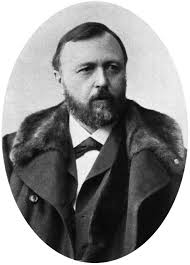 Richard von Krafft-Ebing (August 14, 1840 - December 22, 1902) was a foundational figure in the history of psychiatry and the emerging field of sexology. While his work was
deeply embedded in the prejudices of his time, his legacy remains significant for the role he played in shifting how society understood human sexuality.
Richard von Krafft-Ebing (August 14, 1840 - December 22, 1902) was a foundational figure in the history of psychiatry and the emerging field of sexology. While his work was
deeply embedded in the prejudices of his time, his legacy remains significant for the role he played in shifting how society understood human sexuality.
Born in Mannheim, Germany, he studied medicine at the University of Heidelberg and built a distinguished career as a psychiatrist and neurologist. He served as a
professor at the universities of Strasbourg, Graz, and Vienna.
He is best remembered for his massive clinical volume, Psychopathia Sexualis (first published in 1886). The book was intended as a medical and legal reference to document
what were then termed "sexual perversions," such as sadism, masochism, fetishism, and homosexuality.
Krafft-Ebing was a pioneer in using case studies. He collected hundreds of accounts from patients and correspondents, often publishing their own words. By doing so, he
provided a platform for individuals who had previously been entirely silenced by legal and moral codes.
Krafft-Ebing’s relationship with the history of LGBTQ identities is complex and evolutionary. His work acted as both a tool for pathologization and a gateway to eventual
decriminalization and acceptance.
In the 19th century, same-sex desire was primarily viewed as a moral failing or a criminal act (such as under Paragraph 175 in the German Empire). By reclassifying
same-sex desire as a psychological/physical condition—often theorizing it as "congenital" or "innate"—Krafft-Ebing moved the discourse away from purely moral or criminal
condemnation. He helped pioneer the "born this way" argument, which, while still labeling the condition as a "degeneration" in his early work, removed the stigma of active,
chosen immorality.
Over the many editions of Psychopathia Sexualis, his perspective shifted significantly. By the end of his life, he began to acknowledge that for many, same-sex desire
was a natural, stable part of their identity that did not inherently lead to a life of "pathological" suffering.
Because he recognized that many of his patients were not "criminals" in the traditional sense, he became an advocate for legal reform. He supported efforts to abolish
laws that criminalized same-sex acts.
He eventually aligned himself with early LGBTQ rights activists, including Magnus Hirschfeld. In 1897, he supported the
Scientific-Humanitarian Committee, the first organization dedicated to the rights of homosexuals, and even published his final articles in their journals.
While modern readers often focus on the pathologizing, judgmental, and heteronormative language found in his earlier editions, historians often highlight that
Krafft-Ebing provided a crucial, albeit complicated, service. He treated individuals who were desperate for understanding with enough professional curiosity to let them
speak. By documenting these lives, he helped turn "sexual inversion" into a subject of scientific inquiry rather than just a subject of police reports, creating the space
for the eventual development of modern queer identity and advocacy.
References:
- https://en.wikipedia.org/wiki/Richard_von_Krafft-Ebing
Support this project
This website is a passion project researched, developed, and funded entirely by me. If you find the content valuable and would like to help support the ongoing research and hosting costs, any contribution is deeply appreciated.
Thank you for keeping this independent resource alive!
My books on Amazon: Elisa Rolle's books
BACK TO HOME PAGE